Travel Affiliate Marketing Programs: What to Compare Before Joining


In short
Travel affiliate marketing programs are worth joining when the offer matches a problem your audience is already trying to solve, the commission terms are transparent, and the tracking and payout rules work for your business. Compare fit, commission basis, attribution, restrictions, payment, and disclosure duties before you apply.
- A high commission percentage only matters when it applies to a product readers are likely to buy and the commission is actually payable.
- The most useful travel affiliate programs solve a specific trip problem, such as finding a place to stay, booking an activity, arranging transport, or getting mobile data abroad.
- Attribution rules can matter as much as commission rate because they decide which referral receives credit when a traveler visits several sites before buying.
- eSIM Trading states that approved affiliate partners earn 10% of each attributed order value, with commission paid in USDT after a 30-day dispute window.
Table of contents
- What should you compare before joining a travel affiliate program?
- Which commission model is worth your time?
- Why is “highest paying” usually the wrong question?
- Which travel affiliate program type fits your audience?
- What should beginners set up before publishing affiliate links?
- When does a travel-data eSIM affiliate program fit?
- Frequently asked questions
- What should you do before applying?
A travel affiliate program gives a publisher, creator, or community owner a tracked way to earn a commission when a referred customer completes an eligible action. The best fit is rarely the program with the largest advertised percentage. It is the one that matches what your readers need at the moment they are ready to act.
What should you compare before joining a travel affiliate program?
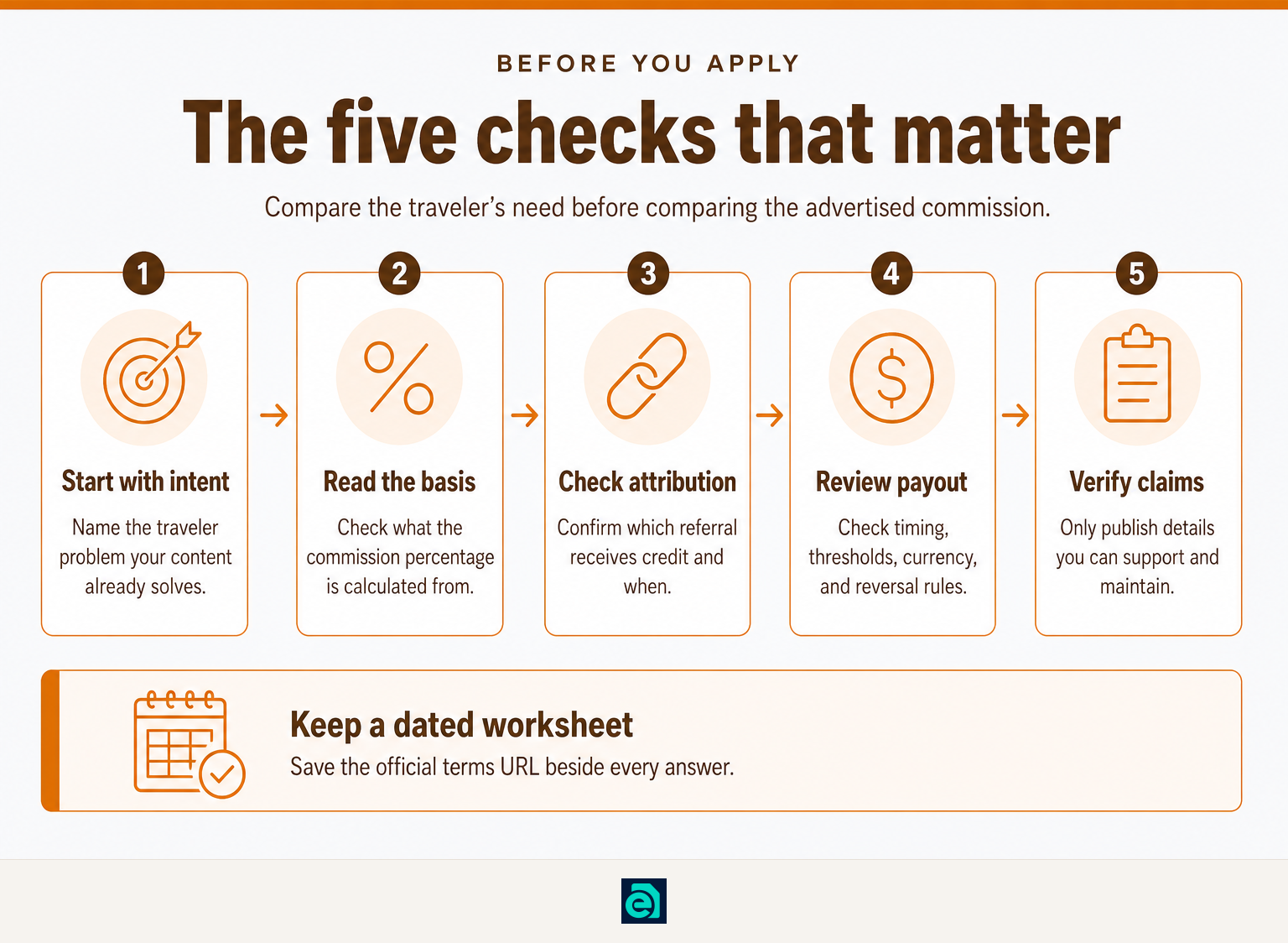
Compare the customer problem, commission basis, attribution rules, payout process, promotion restrictions, and proof you can honestly provide. A program can look generous on a landing page yet be a poor fit if its booking flow, approval rules, or payment method do not suit your audience or business.
Start with audience intent. A destination guide reader may need lodging, activities, transport, or mobile data. A frequent-flyer audience may care more about airport services, insurance, or connectivity. A program is easier to recommend when its offer naturally completes the journey your content has already started.
Then read the commercial terms as if you were auditing a small revenue channel. Ask these questions:
- What action earns commission? It may be a purchase, completed booking, qualified lead, subscription, or first order. These are not equal.
- What is the commission calculated from? It may be a percentage of order value, a percentage of the supplier’s margin, or a fixed amount per sale.
- Who gets credit? Check whether attribution is first-click, last-click, or another stated model, and whether repeat purchases are eligible.
- When and how are you paid? Look for minimum payout thresholds, refund holds, currencies, supported payout methods, and payment frequency.
- What promotion is prohibited? Paid-search bidding, coupon promotion, spam, self-referrals, and misleading claims are common restrictions.
- What can you verify yourself? Do not call an offer the cheapest, fastest, or best unless you can support that claim and keep it current.
Keep a simple worksheet for every affiliate travel program you consider. Put the official terms URL beside each answer and date the entry. That makes later reviews much easier when a provider changes rates, cookie rules, or destination availability.
A good program is the one whose customer problem, economics, and rules all fit the content you already publish.
Which commission model is worth your time?

A percentage commission can be attractive, but the percentage alone does not tell you how much a referral is worth. You need to know what the percentage is applied to, how often readers convert, and how long the transaction remains eligible for attribution.
Three models appear frequently:
| Commission model | What it means | What to check before joining |
|---|---|---|
| Percentage of order value | You receive a stated share of what the customer pays. | Whether taxes, fees, discounts, refunds, or credits are excluded. |
| Percentage of supplier margin | You receive a share of the provider’s profit or commission, not necessarily the traveler’s full purchase price. | The definition of margin and whether it is visible in reporting. |
| Fixed fee per completed action | You receive a set amount for a completed booking, sale, lead, or activation. | The qualification standard and reversal rules. |
A fourth model, recurring commission, can matter for subscription-style travel services. Its value depends on retention and on whether the program pays for renewals, upgrades, or only the first transaction.
Use a basic estimate rather than chasing a headline rate:
Expected commission per 1,000 visitors = visitors × click-through rate × conversion rate × average eligible order value × commission rate
This is not a forecast. It is a way to compare assumptions. A lower-rate offer can earn more if it solves an urgent problem, has a clear checkout, and appears in content where readers have high purchase intent.
For example, an itinerary page may convert readers on a small, immediate travel necessity better than a broad homepage recommendation, even if the order value is lower. That is why content placement matters as much as program category.
A commission rate is only useful when you understand the eligible sale, likely conversion path, and payment terms behind it.
Why is “highest paying” usually the wrong question?

The highest paying travel affiliate program is not a universal answer because earnings depend on the audience, content, geography, purchase timing, and provider rules. A high-ticket offer can produce larger commissions per sale, while a lower-priced offer may convert more often and therefore produce more total revenue.
Treat these as separate questions:
- Highest percentage: Which program advertises the largest rate?
- Highest commission per sale: Which eligible transaction generates the most money?
- Highest expected earnings: Which offer produces the strongest combination of clicks, conversions, order value, and valid attribution for your traffic?
- Lowest operational friction: Which program has reporting, creative assets, payout terms, and rules you can realistically manage?
The third question is usually the useful one. A creator whose readers arrive from destination-specific search content may earn more from relevant practical offers than from expensive products that readers browse but rarely buy.
Also consider reversal risk. If a booking is canceled, refunded, disputed, or judged ineligible under the program terms, a pending commission may disappear. A large advertised rate does not protect against this. Read the treatment of cancellations, chargebacks, and returned goods before using an offer in important content.
The best earning opportunity is the offer that converts honestly for your audience and still pays under the conditions you can verify.
Which travel affiliate program type fits your audience?
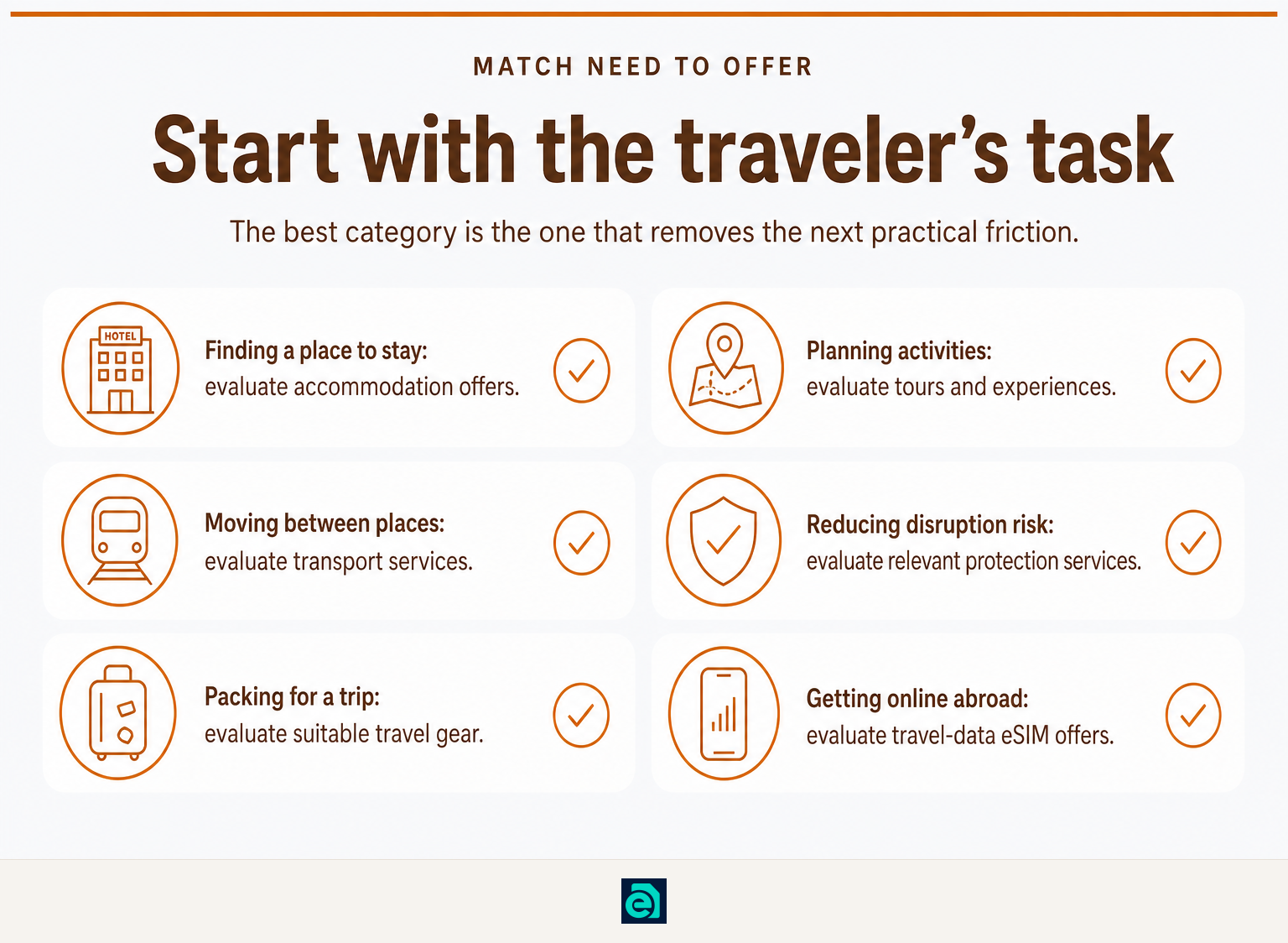
Choose categories before choosing individual programs. Categories keep your recommendations useful because they begin with the traveler’s need rather than the provider’s marketing message.
| If your content helps readers with… | Affiliate category to evaluate | Strong content placement |
|---|---|---|
| Choosing where to stay | Accommodations | Destination guides, neighborhood comparisons, itinerary pages |
| Deciding what to do | Tours and activities | Day plans, attraction guides, seasonal roundups |
| Moving between places | Flights, rail, car hire, transfers, and local transport | Route guides, airport pages, multi-city itineraries |
| Reducing trip risk | Insurance, disruption assistance, or flexible booking services | Long-haul planning guides and practical travel checklists |
| Packing and travel comfort | Luggage, adapters, outdoor equipment, or travel accessories | Gear guides with first-hand use and clear suitability notes |
| Staying online abroad | Travel-data eSIMs and regional data bundles | Arrival guides, remote-work guides, and country-specific connectivity content |
Do not force every category into every article. A long list of unrelated travel affiliate links reduces trust and makes comparison harder for readers. One or two relevant recommendations, with a clear reason for inclusion, are usually more useful than a crowded resource page.
Audience fit also includes purchasing constraints. If your audience has specific payment preferences, travels across multiple countries, needs hotspot support, or relies on one phone for maps and messaging, those needs should shape which offers you place in the content.
Start with the traveler’s immediate task, then choose the affiliate category that removes friction from that task.
What should beginners set up before publishing affiliate links?
Beginners should set up a clear disclosure, a way to track link placement, and a process for checking claims before they publish affiliate content. You do not need a large audience to start, but you do need content that helps a reader make a real travel decision.
For U.S.-facing recommendations, the Federal Trade Commission says a material connection to a brand should be disclosed clearly and placed with the endorsement itself. The FTC also warns that creators cannot claim personal experience with a product they have not tried or make claims that lack proof. Read the FTC’s disclosure guidance for influencers before publishing sponsored or affiliate recommendations. If your audience is international, check whether other advertising rules also apply where you operate or market.
Use this practical pre-publication checklist:
- Put a plain-language affiliate disclosure near the recommendation, not only on a separate policy page.
- Describe the product category and limitations accurately. A data-only eSIM, for example, should not be presented as a replacement for a phone number or SMS service.
- Save the program terms, application confirmation, and key promotion restrictions.
- Tag links by page, campaign, and placement so reporting tells you what actually works.
- Review key destination pages before peak travel periods, especially prices, coverage claims, availability, and promotional terms.
- Build comparison content around decisions you can support, not generic superlatives.
A beginner can build credible affiliate revenue by making fewer, clearer recommendations and checking every claim behind them.
When does a travel-data eSIM affiliate program fit?
A travel-data eSIM affiliate program fits when your audience needs mobile data after arrival, wants to avoid physical SIM swapping, or is planning travel across supported destinations. It is particularly relevant to destination guides, airport-arrival content, remote-work travel, multi-country itineraries, and practical packing checklists.
eSIM Trading’s affiliate programme is designed for creators and channels promoting prepaid, data-only travel connectivity. As of October 2026, eSIM Trading states that affiliates earn 10% of every attributed order value, receive payment in USDT after a 30-day dispute window, and get a unique link, live order and commission reporting, banners, and destination pages in seven languages.
The same published partner terms say that the first affiliate link a customer follows is credited to that partner. That tracking approach is worth understanding before you compare it with other affiliate travel programs, because it affects how your own content is credited when a traveler researches several options.
This offer will not fit every audience. It is data-only, so it should not be recommended to travelers who need a conventional phone number, voice calling, SMS, or SMS one-time-password delivery. It also needs a suitable device and an audience comfortable with the listed payment and payout arrangements.
For the right reader, mobile data is a practical trip purchase rather than an optional extra. A creator can point readers to travel-data eSIM plans where the recommendation belongs in a destination or arrival guide, explain the data-only limitation plainly, and avoid promising coverage or speeds that cannot be guaranteed.
Creators with an audience that makes repeat trips may also find that store-credit rewards give readers a reason to return, but store credit is not the same as cash and should be described accurately.
A travel-data eSIM affiliate offer works best when your content already helps readers solve the immediate problem of getting online abroad.
Frequently asked questions
What is the best travel affiliate program?
The best travel affiliate program is the one that matches your audience’s travel problem, your content format, and your preferred payout and tracking terms. A destination guide may suit an accommodation, activity, transport, or data offer, while a gear-focused audience may need a different category. Check terms before applying because commissions and restrictions change.
What are the highest-paying travel affiliate programs?
The highest-paying travel affiliate programs are not always the most profitable for every publisher. A high percentage may apply to a narrow commission base, while a lower-rate offer can convert more visitors or produce more eligible sales. Compare expected earnings using conversion rate, average eligible order value, attribution rules, reversals, and payout reliability.
Which is the highest paying affiliate program?
There is no single highest paying affiliate program for all creators because commission structures, traffic sources, products, and approval rules differ. Compare the amount paid on an eligible sale, the conversion likelihood for your audience, and the chance of commissions being reversed. A program is valuable only if its terms fit your content and readers.
Is travel affiliate profitable?
Travel affiliate marketing can be profitable when a creator attracts readers with clear purchase intent and recommends relevant products transparently. Profitability is not guaranteed: earnings depend on traffic quality, click-through rate, conversion rate, average order value, attribution rules, cancellations, and the time required to create and maintain useful travel content.
What should you do before applying?
Choose three travel affiliate program categories that match your strongest existing pages, then compare their official terms in one worksheet. Apply only after you can state what the reader gets, what you earn, how attribution works, and what limitations you must disclose.
If travel connectivity is a natural fit for your content, send a partnership enquiry to eSIM Trading with a clear description of your audience, channels, and the travel problems your content already solves.
Ready to travel without roaming bills?
Instant eSIM data plans for 148 countries — delivered as a QR code in under a minute. No account, no contract.
Browse destinations