International SIM Card or Travel eSIM: Which Should You Use Abroad?

In short
A travel eSIM is usually the simplest choice for mobile data abroad if your phone is unlocked and eSIM-compatible, especially when you want to keep your home SIM in place. Choose a physical international SIM instead when you specifically need conventional calls, SMS, or a travel phone number, because many travel eSIMs are data-only.
- A physical international SIM replaces or occupies a SIM slot, while an eSIM is installed digitally on a compatible phone.
- A data-only travel eSIM cannot receive ordinary SMS messages or SMS one-time passcodes, even though internet-based calling and messaging apps can still work.
- A country plan is usually the cleanest fit for one destination; a regional plan can reduce switching when an itinerary crosses borders.
- Before buying either option, confirm that the phone is carrier-unlocked, check coverage for every destination, and read the plan’s validity and fair-usage terms.
Table of contents
- What type of SIM card is best for using abroad?
- Do you need a phone number, SMS, or bank codes while traveling?
- Can you keep your home number and use a travel eSIM for data?
- Should you buy a country plan, regional plan, or global plan?
- Can I just buy a SIM card and put it in my phone?
- How should you compare data, validity, and unlimited plans?
- What should you do before departure?
- Frequently asked questions
What type of SIM card is best for using abroad?
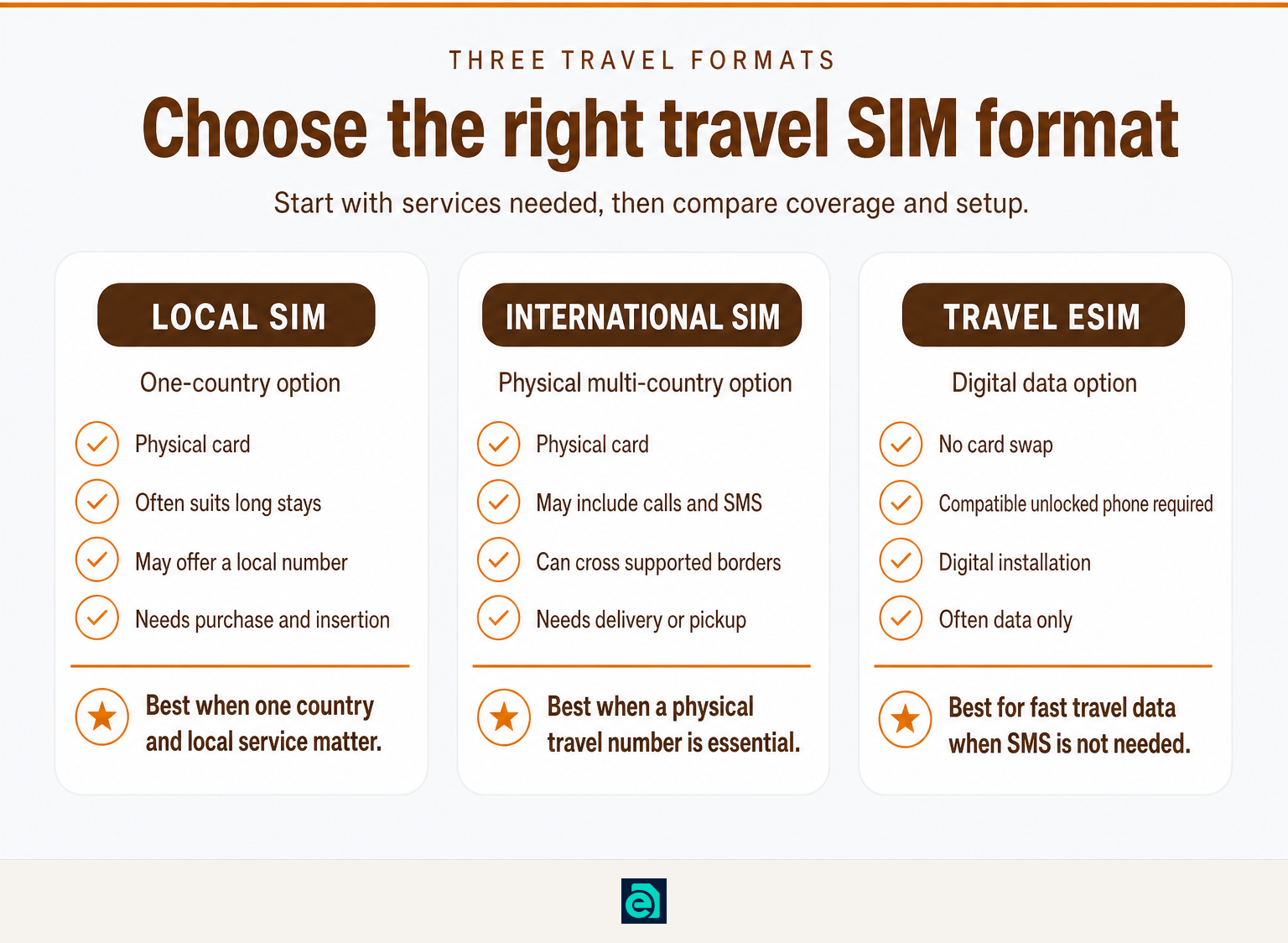
The best SIM option abroad depends first on whether you need data only or also need a phone number, calls, and SMS. For most short trips where maps, messaging, ride apps, bookings, and browsing matter more than conventional calls, a travel eSIM is often the lower-friction option.
There are three practical choices:
- A local physical SIM bought for one country.
- An international physical SIM intended to work across multiple destinations.
- A travel eSIM downloaded directly to an eligible phone.
Apple defines an eSIM as a digital SIM that lets a phone use a cellular plan without a physical nano-SIM. Apple also notes that Dual SIM can pair a physical SIM with an eSIM, or, on supported iPhones, two eSIMs. That setup can let a traveler retain a home line while assigning mobile data to a travel plan. (support.apple.com)
A local physical SIM can work well for a long stay in one country, particularly if a local phone number is important. An international physical SIM can be convenient for multi-country travel, but it still has to be delivered or purchased in person and inserted into the phone. A travel eSIM avoids the card swap, but the exact plan may provide data only.
For a traveler visiting one country for a week or two, the decision is usually simple: choose the option with confirmed coverage, enough data, a validity period that fits the trip, and the services you genuinely need. For an itinerary with several borders, compare regional coverage before buying separate country plans.
The right international SIM is the one that fits the services you need, not the one with the longest feature list.
Do you need a phone number, SMS, or bank codes while traveling?
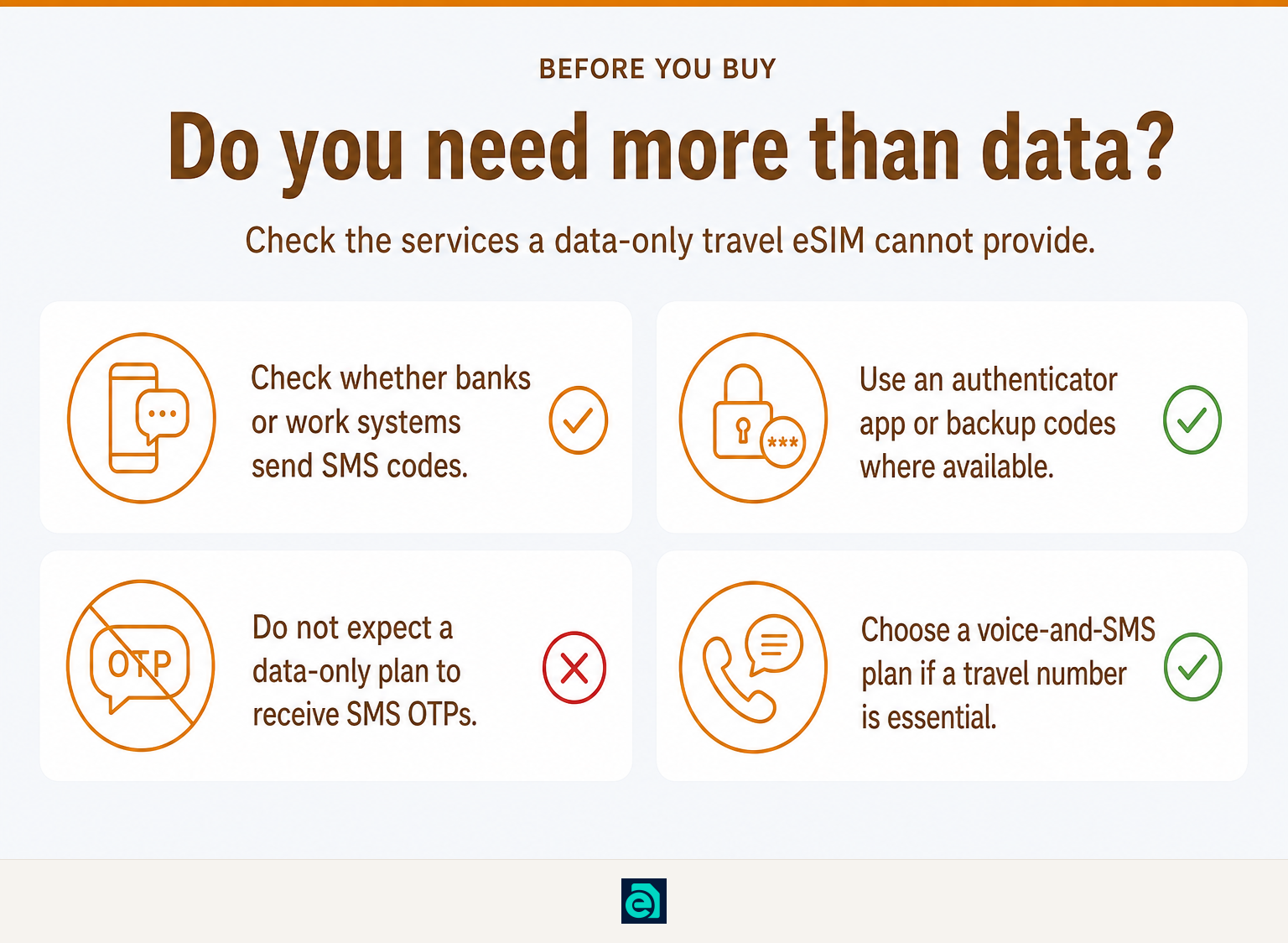
If you need to receive ordinary SMS, make conventional calls, or use a newly issued travel phone number, do not assume a travel eSIM will provide those services. Many travel eSIMs are sold as data-only plans, so they provide mobile internet but no phone number, voice service, or SMS inbox.
That distinction matters most when a bank, airline, work system, or other service sends a one-time code by SMS. A data-only eSIM cannot receive that code because it does not have an SMS-capable mobile number. Internet-based apps such as WhatsApp, Telegram, FaceTime, Signal, and many authenticator apps can still work over the eSIM’s data connection, but that is not the same as receiving an SMS.
At eSIM Trading, the current FAQ states that its travel plans are pure data plans with no voice calls, SMS, phone number, or SMS OTP support. The same FAQ states that data-based calling and messaging apps can work through the connection. (esim-trading.com)
Before you choose a data-only plan, make a short list:
- Does any important account still use SMS verification?
- Can you move those accounts to an authenticator app, email verification, or backup codes before departure?
- Can your home line receive calls or texts through Wi-Fi Calling when Wi-Fi is available?
- Do you need local callers, drivers, hotels, or clients to reach you on a conventional number?
If the answer to the final question is yes, an international physical SIM or local SIM with voice and SMS may be the more suitable format. If you only need reliable internet and can communicate through apps, data-only travel eSIMs are often a more direct fit.
A data-only eSIM is excellent for internet access, but it is the wrong product for a traveler who must receive SMS verification codes.
Can you keep your home number and use a travel eSIM for data?
Yes, many compatible phones can keep a home number active while using a travel eSIM for cellular data. The key requirements are a carrier-unlocked device, eSIM compatibility, and settings that assign mobile data to the travel plan rather than the home line.
On compatible iPhones, Apple says Dual SIM can use a physical SIM and an eSIM, and iPhone 13 models and later can also use two eSIMs. Apple also states that only one cellular data network is used at a time, so travelers should deliberately select the travel line for cellular data. (support.apple.com)
This arrangement is useful because it separates two jobs:
- Home line: retain the existing number for calls, messages, and account access where available.
- Travel eSIM: supply the mobile data connection for maps, browsing, travel apps, and app-based communication.
Keeping the home line enabled does not automatically prevent roaming charges. Before departure, turn off data roaming for the home line, confirm that the travel eSIM is selected for cellular data, and check the home carrier’s policy for incoming calls, SMS, and Wi-Fi Calling. A phone can have the correct SIMs installed and still use the wrong line for data if the settings are not checked.
A dual-SIM setup works best when the home line handles the number and the travel eSIM handles data.
Should you buy a country plan, regional plan, or global plan?
Buy a country plan when most of the trip takes place in one destination. Buy a regional plan when the itinerary includes several covered countries in the same region and you want to avoid installing or changing plans at each border.
A regional plan is not automatically better. The useful question is whether every planned stop is listed in that specific plan’s coverage area. A Europe bundle, for example, may suit a trip across several European destinations, but travelers should still verify each country, the duration, and the stated network terms before checkout.
Use this decision rule:
| Trip pattern | Usually start by comparing | What to verify |
|---|---|---|
| One country | Country eSIM or local SIM | Network coverage, data amount, validity, phone-number need |
| Two or more nearby countries | Regional eSIM | Every country on the route, border-crossing coverage, validity |
| Several far-apart regions | Separate country plans or a global plan | Included destinations, price per GB, validity, service limits |
| Long stay in one country | Local SIM and country eSIM options | Local number requirement, data cost, renewal process |
eSIM Trading lists both country plans and regional bundles. Travelers moving between several European destinations can review the current regional Europe eSIM bundles rather than buying a separate plan for every stop. Its destination list and plan terms remain the source of truth because coverage and available allowances can change. (esim-trading.com)
For trip research after arrival, mobile data can also be useful for checking practical destination details. For example, a Maui kayaking planning guide covers kayaking areas, conditions, and guided kayak-snorkel options for travelers building a Maui itinerary.
A regional plan earns its place only when it covers the whole route you will actually travel.
Can I just buy a SIM card and put it in my phone?
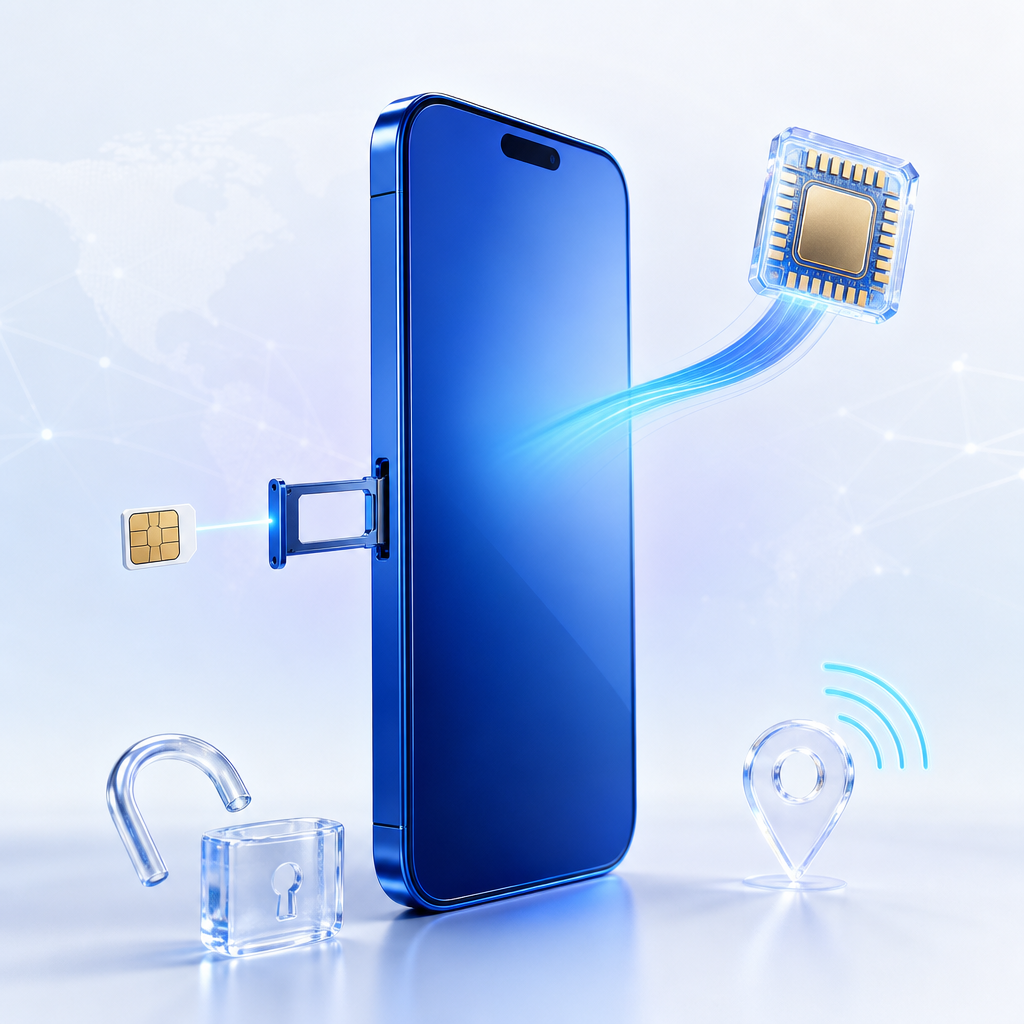
You can insert a physical SIM into an unlocked phone with a compatible SIM tray, but inserting the card is only one part of setup. The plan must be active, the phone must support the required network bands, and the SIM must have coverage in the country where you intend to use it.
For a travel eSIM, the equivalent process is digital: purchase the plan, receive an activation method, install the eSIM, and select it for cellular data when needed. eSIM Trading says it delivers a QR code, a manual LPA activation code, and, on supported devices, a one-tap installation link after payment confirmation. Its Terms, last updated September 14, 2026, also say that travelers are responsible for confirming eSIM compatibility and carrier unlocking before purchase. (esim-trading.com)
Physical SIMs have one practical downside that is easy to overlook: removing the home SIM means storing a small card safely for the whole trip. It can also make the home number unavailable on the device unless the phone supports another active line. An eSIM can avoid that swap, but only if the phone supports it.
If you are unsure whether an iPhone can use an eSIM, check the phone’s model, carrier-lock status, and active-line capacity before buying. Apple’s Dual SIM documentation specifically lists an iPhone XS, iPhone XS Max, iPhone XR, or later as the baseline iPhone family for eSIM use, with regional model exceptions noted by Apple. (support.apple.com)
Buying a SIM is easy; confirming compatibility, activation timing, and line settings is what prevents a bad arrival-day surprise.
How should you compare data, validity, and unlimited plans?
Compare the total data allowance and validity period before you compare headline prices. A cheap plan is not useful if its validity starts before you travel, expires halfway through the trip, or runs out after a day of navigation, video, hotspot use, and uploads.
Start with trip behavior rather than a generic data number:
- Light use: maps, messages, email, ride apps, and occasional browsing.
- Moderate use: social media, frequent photo uploads, video calls, and online booking.
- Heavy use: hotspot tethering, streaming, cloud backups, remote work, or multiple devices.
“Unlimited” needs particularly careful reading. Some plans sold as unlimited provide a stated amount of high-speed data before speeds are reduced. At eSIM Trading, the current FAQ says its unlimited plans include high-speed allowances of 30 GB for 7 days, 45 GB for 15 days, and 70 GB for 30 days, followed by reduced speed; the company’s Fair Usage Policy forms part of the plan terms. (esim-trading.com)
Hotspot use counts too. eSIM Trading’s Terms state that tethering is included with every plan but counts toward the plan’s data and fair-usage limits. Read the current Fair Usage Policy before choosing an unlimited-labelled plan for laptop work or a shared connection.
| Compare this | Why it matters |
|---|---|
| Data allowance | Determines how much full-speed data is included. |
| Validity period | Must cover the travel dates and the provider’s activation rules. |
| Network coverage | Can differ by destination, city, and local partner network. |
| Hotspot permission | Matters if a laptop, tablet, or another traveler will use the connection. |
| Speed policy | Explains whether an unlimited-labelled plan may slow after a threshold. |
| Calls, SMS, and number | Determines whether the plan can support ordinary phone service or SMS codes. |
The plan label matters less than the allowance, validity, coverage, and speed terms behind it.
What should you do before departure?
Install or at least save the travel eSIM instructions while you still have dependable internet, then confirm the travel line is ready without accidentally using it before the plan’s stated activation point. Keep the QR code or manual activation details private, because anyone who receives them may be able to install the plan.
A practical pre-departure checklist:
- Confirm that the phone is unlocked and eSIM-compatible.
- Check that the plan covers every destination and planned border crossing.
- Decide whether a country plan, regional plan, or global plan matches the itinerary.
- Confirm whether the plan includes only data or also a phone number, calls, and SMS.
- Move critical logins away from SMS-only verification where possible.
- Save activation instructions offline and do not share the QR code.
- Set the travel eSIM as the cellular-data line after installation.
- Turn off data roaming on the home line unless you intentionally want carrier roaming.
At eSIM Trading, travelers can browse travel eSIM plans by destination and receive installation details digitally after the payment process is confirmed. The company’s current Terms say delivery normally completes within a minute, but that timing depends on payment confirmation and should not be treated as a substitute for installing early. (esim-trading.com)
If you buy a plan and later change your mind, check refund terms before activation. eSIM Trading’s September 14, 2026 Terms say an unactivated eSIM can be eligible for a full refund within seven days of purchase, while activated eSIMs are non-refundable except where the service was not delivered or was unusable due to a fault on its side. Review the current eSIM Trading Terms before ordering because digital-goods rules and product terms can change. (esim-trading.com)
The best time to solve compatibility, SMS access, and roaming settings is before the flight, not after landing.
Frequently asked questions
Which SIM card is best for international use?
The best SIM card for international use depends on the services you need. A data-only travel eSIM is often best for mobile internet on a compatible unlocked phone, while an international physical SIM or local SIM can be better when you need calls, SMS, or a travel phone number. Always verify coverage and validity for each destination.
Is there a SIM card that works internationally?
Yes. International physical SIMs and many travel eSIM plans are designed to work across more than one country, but coverage, networks, data allowances, calls, SMS, and prices vary by plan. A regional plan may suit nearby countries, while a global plan may suit broader itineraries. Check the provider’s current destination list before purchase.
What type of SIM card is best for using abroad?
A travel eSIM is often the best type of SIM for using abroad when a traveler wants mobile data without swapping a physical card and does not need SMS or a new number. A physical SIM can be more suitable for travelers who need conventional voice calls, text messages, or local number service.
Can I just buy a SIM card and put it in my phone?
Yes, if the phone is carrier-unlocked, has a compatible SIM tray, and supports the destination network. A physical SIM also needs an active plan and correct phone settings. For a travel eSIM, the comparable process is installing a digital plan through a QR code, activation code, or provider-supported installation method.
Choose the format before you choose the plan
Start with the non-negotiable question: do you need a phone number and SMS, or do you only need data? If data is enough, choose a compatible travel eSIM with coverage and validity that match the itinerary. If ordinary calls, texts, or SMS codes are essential, choose a plan type that explicitly includes them before you pay.
Ready to travel without roaming bills?
Instant eSIM data plans for 148 countries — delivered as a QR code in under a minute. No account, no contract.
Browse destinations