How Much Are International Roaming Charges, and What Triggers Them?

In short
International roaming charges can be a daily pass, an included plan benefit, or pay-per-use billing for data, calls, and texts. The amount depends on your home plan, destination, and how your phone connects abroad, so the safest way to budget is to identify the pricing model before your trip.
Key takeaways
- International roaming starts when a phone uses a network outside its home carrier's normal coverage area.
- A daily roaming pass can be convenient, but a $12 daily fee becomes $84 over seven active days.
- Pay-per-use roaming is the least predictable option because the rate can vary by destination and service type.
- Turning off data roaming stops cellular data use on that line, but it does not automatically prevent all possible call, text, or service charges.
- A prepaid travel eSIM can make mobile-data spending fixed in advance, but data-only plans do not provide a regular phone number, voice minutes, or SMS.
Contents
- What actually triggers international roaming charges?
- How much does international roaming cost?
- Which roaming pricing model are you paying for?
- How can you estimate your total trip cost before you fly?
- What is the cheapest way to use your phone internationally?
- Frequently asked questions
What actually triggers international roaming charges?
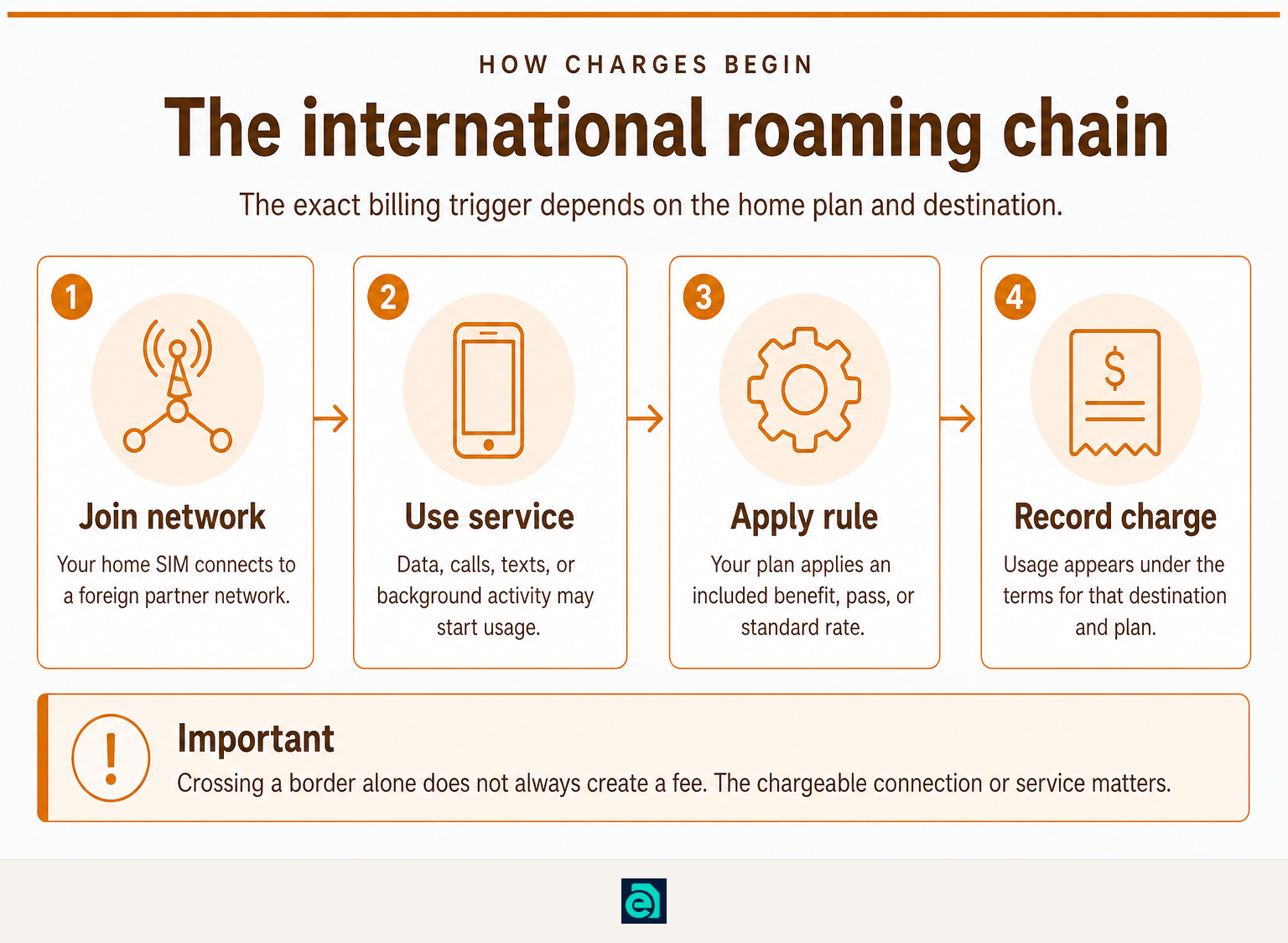
International roaming charges can begin when your home SIM connects to a foreign partner network and uses a chargeable service. That service may be cellular data, a call, a text, or a daily-pass activation event defined in your plan's terms.
The Federal Communications Commission explains that international roaming happens when a mobile device uses a foreign carrier's network, and it warns that rates can be much higher than domestic prices. Read the FCC's international roaming guidance. ([]())
A phone can create data activity without a deliberate browsing session. Common examples include app refreshes, cloud photo backup, map updates, email synchronization, and system updates. If a daily pass is attached to the line, the exact trigger may be any use covered by that pass, so check the carrier's destination-specific terms before relying on a midnight reset or a 24-hour clock.
If your goal is to keep the home line quiet while retaining mobile data, follow our guide to prevent roaming charges without losing mobile data abroad. It explains the phone settings that reduce the chance of unintended cellular use.
International roaming charges begin with a foreign-network connection and a chargeable service, not simply with crossing a border.
How much does international roaming cost?
International roaming can cost nothing extra on an eligible plan, a fixed fee for each active day, or a variable pay-per-use amount. There is no universal roaming price because eligibility, destination coverage, allowances, and billing rules differ by carrier and plan.
As checked on October 6, 2026, official U.S. carrier examples show why travelers should calculate the full trip rather than focus on one day's price: one daily-pass offer lists $6 per day in Mexico and Canada and $12 per day elsewhere, while another lists $12 per day in more than 210 destinations. (verizon.com)
For a seven-day trip, a $12 daily pass is $84 if it activates on all seven days. For a three-day trip, the same pass is $36. Those are examples of the math, not a promise that your plan costs $12 or that it activates in the same way.
The cost can rise if your plan has a high-speed allowance, a daily data cap, a reduced-speed threshold, or separate charges outside the included destination list. Cruise ships and aircraft are separate cases: AT&T, for example, lists a $20 daily cruise option and states that coverage and restrictions vary. (att.com)
The useful question is not "how much is roaming charges?" but "which billing model will my phone use in this destination?"
Which roaming pricing model are you paying for?
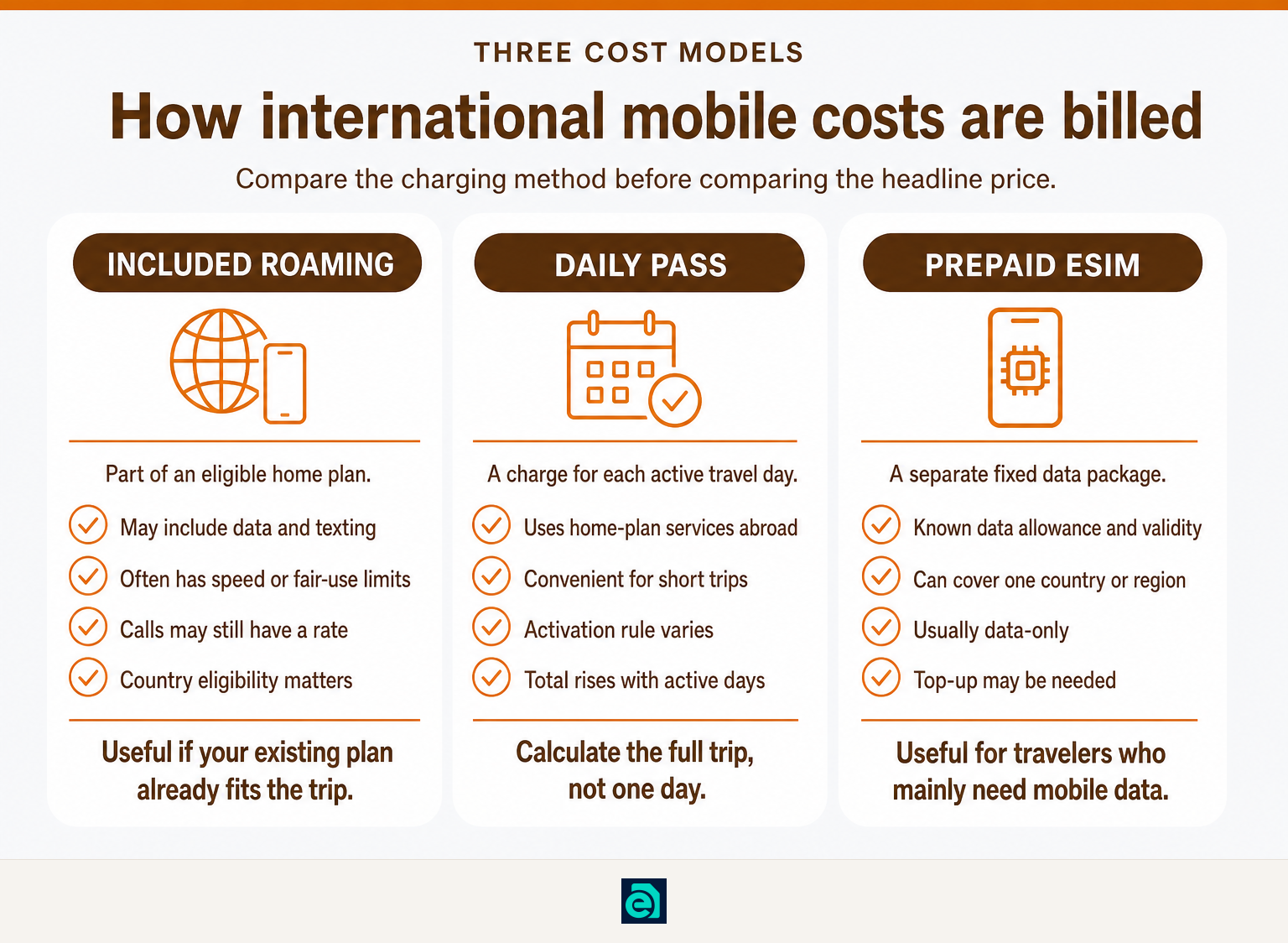
Most travelers fall into one of three international connectivity models: included roaming, a carrier daily pass, or pay-per-use service. A prepaid travel eSIM is different because it is a separate, fixed-price data plan rather than roaming on the home SIM.
| Model | How the cost usually works | Best fit | Main thing to check |
|---|---|---|---|
| Included roaming | International use is included with an eligible domestic plan, often with a high-speed limit or slower speeds after an allowance. | Frequent travelers already on a qualifying plan. | Covered countries, high-speed data limit, call rate, and fair-use restrictions. |
| Daily roaming pass | A fixed charge applies for a day when a qualifying service triggers the pass. | Short trips where convenience matters more than the lowest possible data cost. | What starts the pass, daily period, allowance, and destination list. |
| Pay-per-use roaming | Data, calls, and texts are billed under destination-specific rates without a travel add-on. | Emergency use only. | Per-MB, per-minute, and per-text rates before turning cellular service on. |
| Prepaid travel eSIM | You buy a stated data allowance and validity period before or during the trip. | Travelers who mainly need mobile data and want a known upfront budget. | Device compatibility, coverage, data amount, validity, and whether the plan is data-only. |
Some plans include international data as part of the monthly subscription. For example, T-Mobile currently advertises qualifying plans with 5 GB or 15 GB of high-speed data in 215+ destinations, followed by unlimited data at reduced speeds, plus $0.50-per-minute calls. Eligibility and restrictions still apply. (t-mobile.com)
A prepaid eSIM does not automatically replace every function of a home line. eSIM Trading's country and regional plans are data-only, so they are useful for maps, messaging apps, browsing, and hotspot use, but they do not provide ordinary voice calling, SMS, or SMS one-time-password reception. For a broader choice between formats, see international SIM card or travel eSIM.
Included roaming is easiest when your existing plan already fits the trip, while a prepaid data plan makes the data budget visible before you connect.
How can you estimate your total trip cost before you fly?

Estimate international phone costs by multiplying the likely number of active roaming days by the daily fee, then adding any separate costs for calls, texts, excess data, or a second data plan. The estimate is only useful if it uses your exact destination and your exact domestic plan.
Use this simple comparison:
“text Daily-pass estimate = daily fee × days likely to trigger it Prepaid eSIM estimate = listed plan price + any intentional top-up “
For example, if a daily pass is $12 and you expect it to activate for seven days, budget $84. If you buy a fixed-data eSIM for the same trip, the upfront plan price is your starting data cost, though you may need a top-up if your usage exceeds the allowance.
Before deciding, write down four details:
- Trip length: Count the days you are likely to use cellular service, not just your flight dates.
- Destination coverage: A plan that works in one country may use different terms in another.
- Data demand: Navigation and messaging need little data compared with video calls, social uploads, or hotspot work.
- Home-line needs: Keep the home line available only if you need its number for calls, texts, banking alerts, or account verification.
If you use Verizon, the carrier-specific details belong in our guide to Verizon international roaming charges, including TravelPass settings and alternatives.
A trip estimate becomes reliable only when it includes your destination, active days, expected data use, and any need to keep the home line working.
What is the cheapest way to use your phone internationally?
The cheapest option depends on what you need your phone to do. For travelers who only need data, a prepaid eSIM can be less expensive and more predictable than paying a daily charge for every day abroad, especially on longer trips.
A daily pass may still be worthwhile for a very short trip, for someone who needs ordinary calling and SMS on the home number, or for a plan that already includes a meaningful roaming benefit. Pay-per-use roaming is usually the least suitable choice for planned travel because it leaves the final cost dependent on the destination's rates and unplanned usage.
For data-focused travel, compare the allowance, validity period, coverage countries, and upfront plan price before departure. You can browse prepaid eSIM pricing by destination or choose a regional plan if the itinerary crosses borders. We sell country and regional travel-data eSIMs, but travelers who need voice, SMS, or a phone number should keep an appropriate home-carrier option active.
The cheapest international phone setup is the one that matches the services you actually need, rather than paying for a home-plan feature you will not use.
Frequently asked questions
Do I get charged for international roaming?
You may be charged for international roaming when your home SIM connects to and uses a foreign mobile network, unless your plan includes roaming in that destination. Charges can be a daily pass, an included-plan benefit, or pay-per-use billing. Check your carrier's destination page before travel because plan eligibility and coverage differ. ([]())
What is the cheapest way to use your phone internationally?
The cheapest method depends on whether you need data only or also need ordinary calls and SMS on your home number. A prepaid travel eSIM can provide a fixed upfront data budget, while an eligible roaming benefit may be better for short trips or home-number access. Compare total trip costs, not just daily prices.
How much does international roaming cost?
International roaming can be included in a qualifying plan, charged as a daily pass, or billed at destination-specific pay-per-use rates. As of October 6, 2026, official U.S. daily-pass examples include $6 to $12 per day on land, but those examples are not universal rates and can change. (verizon.com)
Will I still be charged if I turn off data roaming on my phone?
Turning off data roaming stops cellular data use for that line, which helps prevent data-roaming charges. It does not necessarily prevent charges for voice calls, text messages, voicemail, or another service that uses the home line. Airplane mode is more restrictive, but Wi-Fi can then be turned on manually when needed.
What should you check before connecting abroad?
Check the destination, the exact plan on your home line, the trigger for a daily fee, the high-speed data limit, and whether you need calls or SMS. If mobile data is the main requirement, choose a prepaid eSIM allowance before your flight and keep the home line set up only for the services that truly need it.
The best time to prevent an international roaming surprise is before your phone joins a foreign network.
Ready to travel without roaming bills?
Instant eSIM data plans for 148 countries — delivered as a QR code in under a minute. No account, no contract.
Browse destinations