Verizon Wireless Roaming Charges: TravelPass Fees, Triggers and eSIM Options

In short
Verizon international roaming charges can start when a TravelPass-enabled line makes or receives a call, sends a text, or uses cellular data abroad, including background activity. On October 4, 2026, Verizon listed TravelPass at $6 per day in Canada and Mexico and $12 per day in other covered destinations; a data-only travel eSIM can carry mobile data while Verizon cellular service stays off.
Key takeaways
- Verizon listed TravelPass at $6 per day in Canada and Mexico and $12 per day in other covered destinations on October 4, 2026.
- A TravelPass session can begin with a call, text, or cellular-data use, including background app refresh, email syncing, and software updates.
- At the $12 daily rate, eight TravelPass days cost $96 and nine days cost $108, which is more than Verizon's $100 International Monthly Plan before taxes and other account-specific charges.
- A data-only travel eSIM can provide mobile data while you keep your Verizon number inactive for cellular service, but it cannot replace Verizon voice calls, texts, or SMS verification codes.
Table of contents
- What will Verizon charge me abroad?
- What starts a Verizon TravelPass day?
- Should I turn roaming on or off on Verizon?
- When does Verizon's $100 monthly plan make more sense?
- Can a data-only travel eSIM reduce Verizon roaming charges?
- What else do Verizon travelers ask before leaving?
- What should you do before boarding?
Verizon's official international pages are the source of truth for the destination, device, and plan on your account. This guide explains the published terms checked on October 4, 2026, then shows how to avoid an accidental TravelPass day if you prefer to use separate prepaid travel data.
What will Verizon charge me abroad?
For covered destinations, Verizon listed TravelPass at $6 per day in Canada and Mexico and $12 per day in more than 210 other countries and destinations on October 4, 2026. Verizon also listed a $100 International Monthly Plan with 20 GB of high-speed data, unlimited data at 3G speeds afterward, unlimited texts, and 250 minutes. Verizon's International Travel page is the page to check before every trip because coverage and terms can change.
TravelPass is a daily option, not a flat trip price. Verizon says that its included high-speed-data allowance is 5 GB for each TravelPass session, followed by unlimited data at 3G speeds for the rest of that session. A session lasts 24 hours once triggered.
If you travel without a qualifying international plan, or travel somewhere outside the plan's included destinations, Verizon says pay-as-you-go rates can apply to calls, texts, and each MB of data. That is the situation to avoid most carefully because even a small amount of mobile data can be expensive compared with a prepaid travel-data plan.
For Canada and Mexico, do not assume the $6 daily rate applies to your line. Verizon says calling, texting, and data in those countries are included with its Unlimited mobile plans, so check your own plan features in My Verizon before adding anything.
The important point is simple: Verizon roaming charges depend on your destination, plan, and whether your Verizon line actually uses cellular service abroad.
What starts a Verizon TravelPass day?
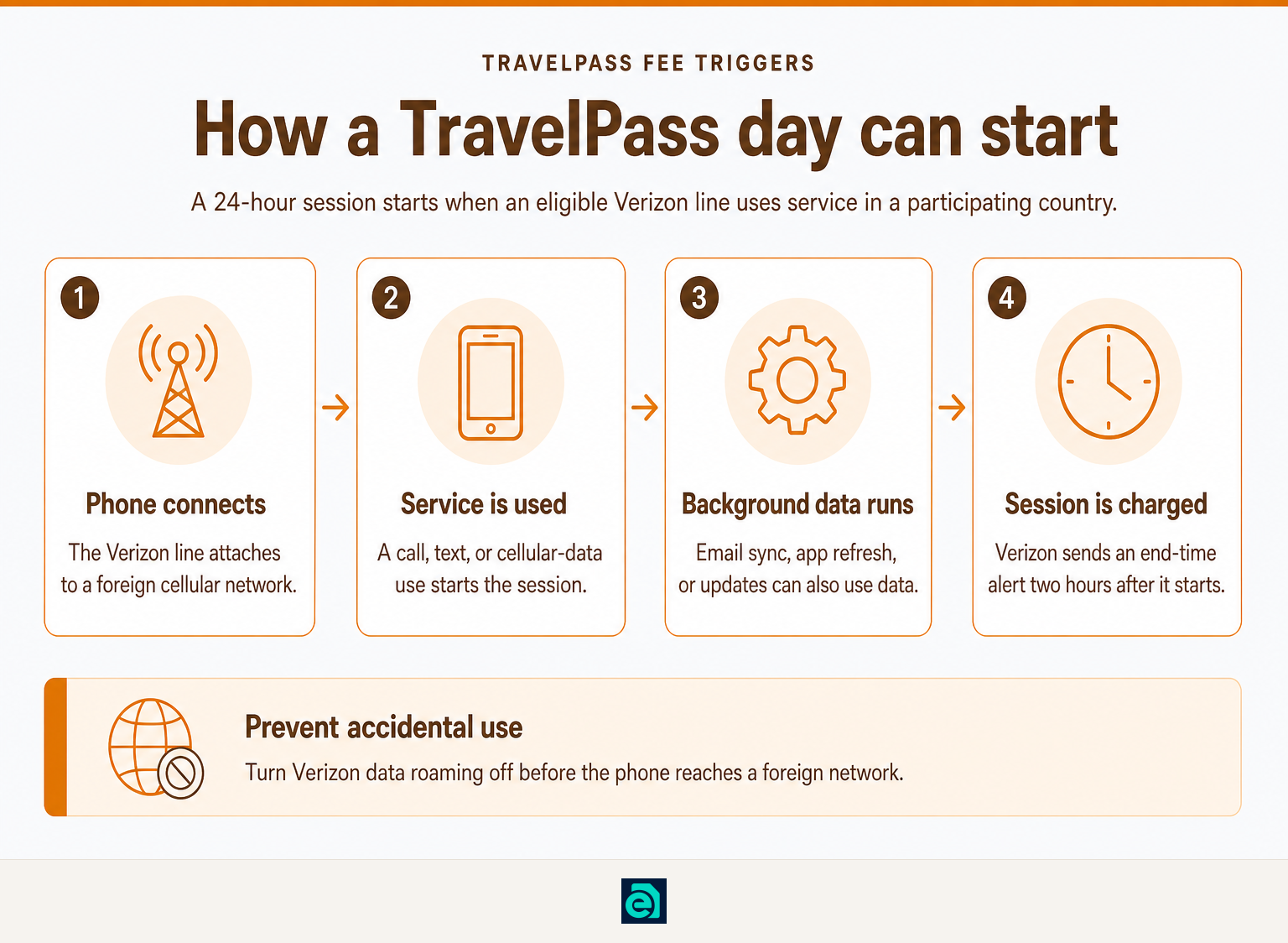
A Verizon TravelPass session starts automatically when an eligible line uses the phone in a participating country. Verizon says a call, an answered call, a sent text, or cellular-data use can start the 24-hour session.
The easy mistake is assuming that only deliberate browsing counts. Verizon specifically lists background app refresh, email syncing, and device or app software updates as background data that can trigger TravelPass after cellular data or data roaming is enabled. Verizon sends a text two hours after a session starts with the session end time. Read the current TravelPass FAQ before departure because that page carries the carrier's detailed trigger rules.
A layover can matter, too. Verizon says travel through two countries during one 24-hour session does not create a second charge if both countries have the same TravelPass daily fee. If the countries have different daily fees, a new fee and a new session can begin.
You can prevent many accidental triggers by switching off the Verizon line's cellular data and data roaming before landing, rather than waiting until the phone attaches to a foreign network.
Should I turn roaming on or off on Verizon?
Turn Verizon data roaming off if your goal is to avoid Verizon cellular-data use abroad. Turn it on only when you have decided to use Verizon roaming and accept the relevant plan or pay-as-you-go terms.
The right setting depends on the job you want the Verizon line to do:
- No Verizon use abroad: Turn the Verizon line off in your phone's cellular settings, or at minimum turn off its data roaming and cellular data. This is the lowest-risk option for avoiding a TravelPass trigger.
- Keep your Verizon number available: Keep the line enabled only when you need it, but remember that calls, texts, and cellular data can start TravelPass. A data-only travel eSIM cannot receive texts or calls sent to your Verizon number.
- Use a separate travel eSIM for data: Set the travel eSIM as the mobile-data line, leave Verizon data roaming off, and disable automatic cellular-data switching if your phone offers that setting.
For a wider checklist covering airplane mode, app updates, cellular settings, and eSIM setup, see how to prevent roaming charges.
Leaving data roaming off on the Verizon line is the clearest way to stop Verizon data from quietly starting a TravelPass session.
When does Verizon's $100 monthly plan make more sense?
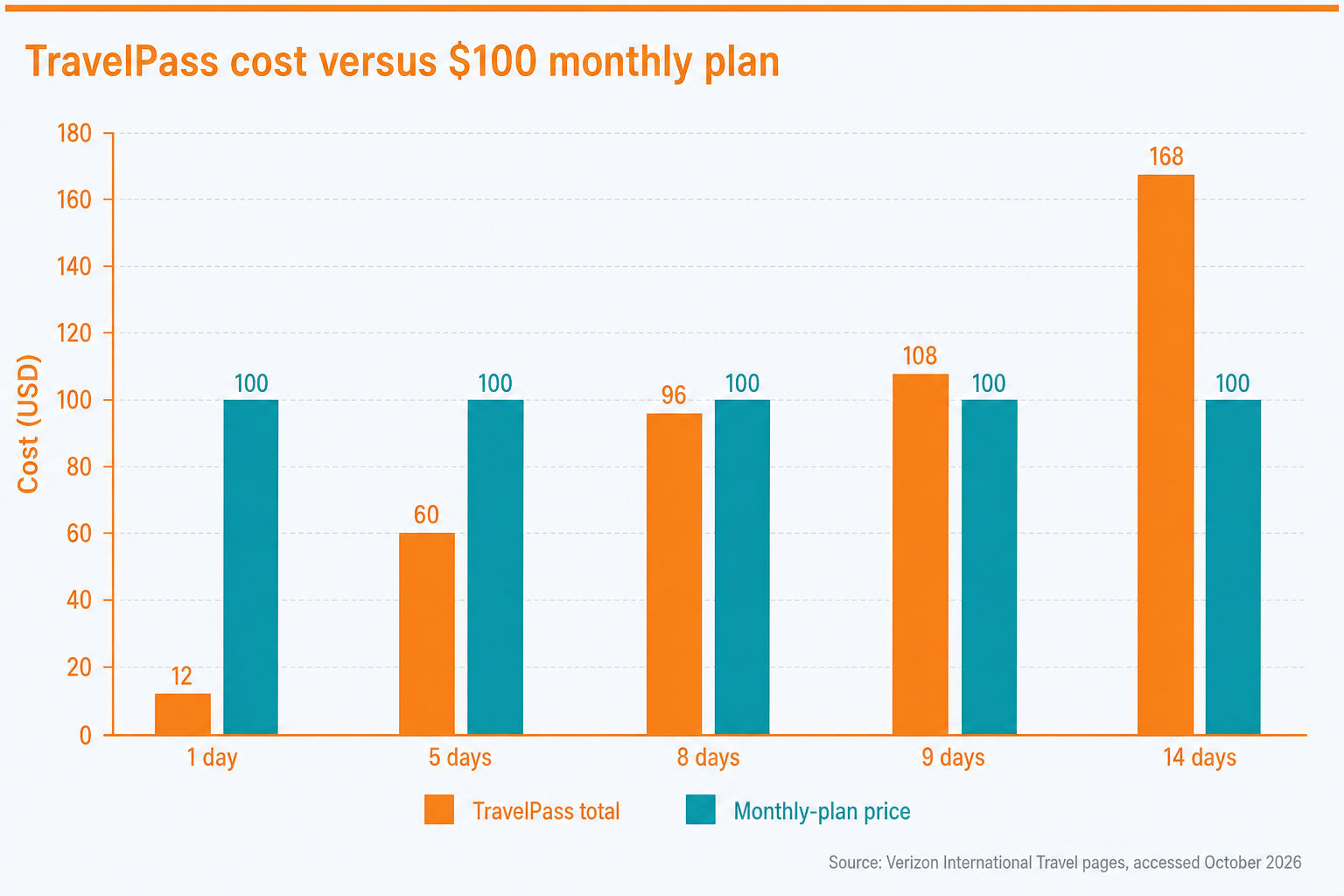
At Verizon's $12 TravelPass rate, the published $100 monthly-plan price becomes lower on the ninth day of paid use. Eight days at $12 total $96, while nine days total $108; Verizon itself describes its $100 International Monthly Plan as suitable for trips of nine days or longer.
That comparison applies only where your TravelPass price is $12 per day and you use your phone on each counted day. It does not mean the monthly plan is automatically best for a nine-day trip to Canada or Mexico, where Verizon listed a $6 daily rate and some Unlimited plans include service. It also does not account for any account-specific features, taxes, or plan changes.
For trips covering several countries, price is only one part of the decision. Our guide to an international SIM card or travel eSIM explains the differences in installation, number retention, and multi-country coverage.
At the $12 TravelPass rate, paid use on nine days costs more than the listed $100 monthly-plan price.
Can a data-only travel eSIM reduce Verizon roaming charges?
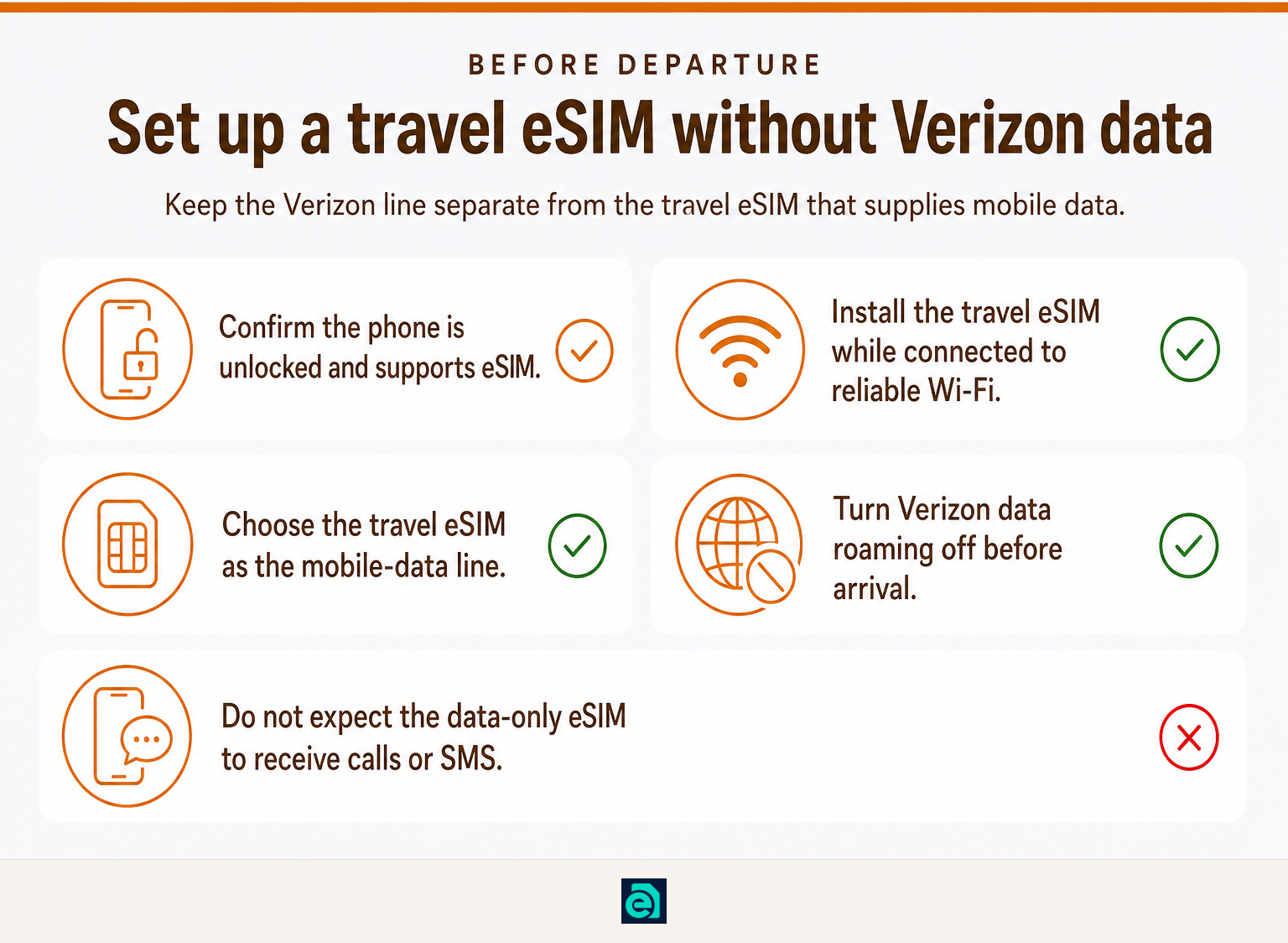
Yes, a separate data-only travel eSIM can reduce Verizon roaming charges when it handles your mobile data and the Verizon line does not use cellular service abroad. It is not a replacement for your Verizon phone number, calls, SMS, or SMS one-time passwords.
This approach works best on an unlocked dual-SIM phone. Install the travel eSIM before departure, set it as the phone's mobile-data line, and keep Verizon data roaming off. On iPhone, also turn off Allow Cellular Data Switching so the phone does not fall back to Verizon data when the travel eSIM signal is weak.
Use this setup sequence:
- Confirm your phone supports eSIM and is unlocked for another carrier.
- Choose a country plan or regional plan that matches your itinerary. For a multi-country trip, compare a Europe travel eSIM plan with individual country plans before buying.
- Install the eSIM while you have reliable Wi-Fi and save the activation details somewhere accessible offline.
- Make the travel eSIM your mobile-data line and turn Verizon data roaming off.
- Keep the Verizon line off if avoiding all Verizon international charges matters more than receiving your usual number's calls and texts.
At eSIM Trading, the available plans are prepaid data plans, so they are designed for maps, messaging apps, bookings, and browsing rather than conventional voice calls and SMS. Check the destination plan's data allowance, validity period, and network details before purchase.
A travel eSIM can reduce Verizon data use, but only a careful line-by-line phone setup prevents Verizon calls, texts, or cellular data from creating a TravelPass session.
What else do Verizon travelers ask before leaving?
Does Verizon offer free international roaming?
Verizon does not describe TravelPass as free international roaming. On October 4, 2026, Verizon listed TravelPass at $6 per day in Canada and Mexico and $12 per day in other covered destinations, although service in Canada and Mexico is included with Verizon Unlimited mobile plans and certain select plans. Check the features on your exact plan before traveling.
How do I avoid getting charged for My Verizon travel pass?
To avoid a Verizon TravelPass charge, prevent the Verizon line from making or receiving calls, sending texts, or using cellular data in a TravelPass country. Turn off the Verizon line or turn off its cellular data and data roaming before arrival. Background activity such as email syncing and app refresh can trigger a session when Verizon cellular data is enabled.
Should I turn roaming on or off Verizon?
Turn Verizon roaming off when you do not want the Verizon line to use foreign cellular networks for data. Turn it on only when you intend to use Verizon's international service and understand the applicable plan terms. If a separate travel eSIM provides mobile data, set that eSIM as the data line and keep Verizon data roaming off.
Which Verizon plan is best for international travel?
The best Verizon international option depends on destination, trip length, daily usage, and whether your existing plan includes Canada or Mexico. Verizon lists TravelPass for occasional daily use and a $100 International Monthly Plan for longer trips. Travelers who mainly need data may prefer a separate prepaid travel eSIM while retaining Verizon only for their usual number.
The right choice is the one that matches the days you will use cellular service, not simply the number of nights on the itinerary.
What should you do before boarding?
Open Verizon's destination planner and confirm your line's plan benefits, TravelPass status, and destination coverage. Then decide before the trip whether Verizon will handle your calls, texts, and data, or whether a separate eSIM will handle data while Verizon stays inactive for cellular service.
If separate prepaid data suits the trip, compare destinations and regional bundles on eSIM Trading's travel eSIM catalog before you leave Wi-Fi behind.
Ready to travel without roaming bills?
Instant eSIM data plans for 148 countries — delivered as a QR code in under a minute. No account, no contract.
Browse destinations