International Data Plans Compared: Roaming, SIM Cards, and Travel eSIMs

In short
International data plans are easiest to choose when you start with the trip, not the provider: use a home-carrier roaming pass for short, convenience-first trips; a local SIM for a long stay in one country; and a regional or global travel eSIM when you want prepaid data across borders. Check coverage, validity, fair-use limits, device compatibility, and whether you need calls or SMS before paying.
Key takeaways
- A daily roaming pass can be convenient for a short trip, but its total cost rises with every day that the pass is active.
- A local physical SIM can work well for a longer stay in one country, but it may require store time, identification, and swapping your home SIM.
- A regional eSIM is usually the simplest prepaid option for a multi-country trip within one region because one profile can cover several destinations.
- A global eSIM is most useful for travelers crossing regions, making repeat trips, or wanting one prepaid data option rather than several country plans.
- Data-only travel eSIMs do not provide a regular phone number, so they are not the right choice if you must receive standard SMS codes or place ordinary cellular calls.
On this page
- What is the best way to get mobile data while traveling internationally?
- When does a home-carrier roaming pass make sense?
- Is a local physical SIM still worth buying?
- When should you choose a regional or global travel-eSIM?
- How do you compare international data plans without a misleading price?
- What must you check before buying an international data plan?
- Frequently asked questions
An international data plan is any arrangement that gives your phone mobile internet outside your home country. The right arrangement is not always the cheapest item on a comparison page. It is the option that covers every stop on your itinerary, lasts long enough, and does not leave you without the service you actually need.
The United States Federal Communications Commission advises travelers to ask about roaming rates and arrangements before traveling, including options from providers in the destination country. That advice matters because a plan can look simple until daily charges, speed limits, network exclusions, or data-only restrictions appear in the fine print. See the FCC international roaming guide before relying on a home plan abroad.
What is the best way to get mobile data while traveling internationally?
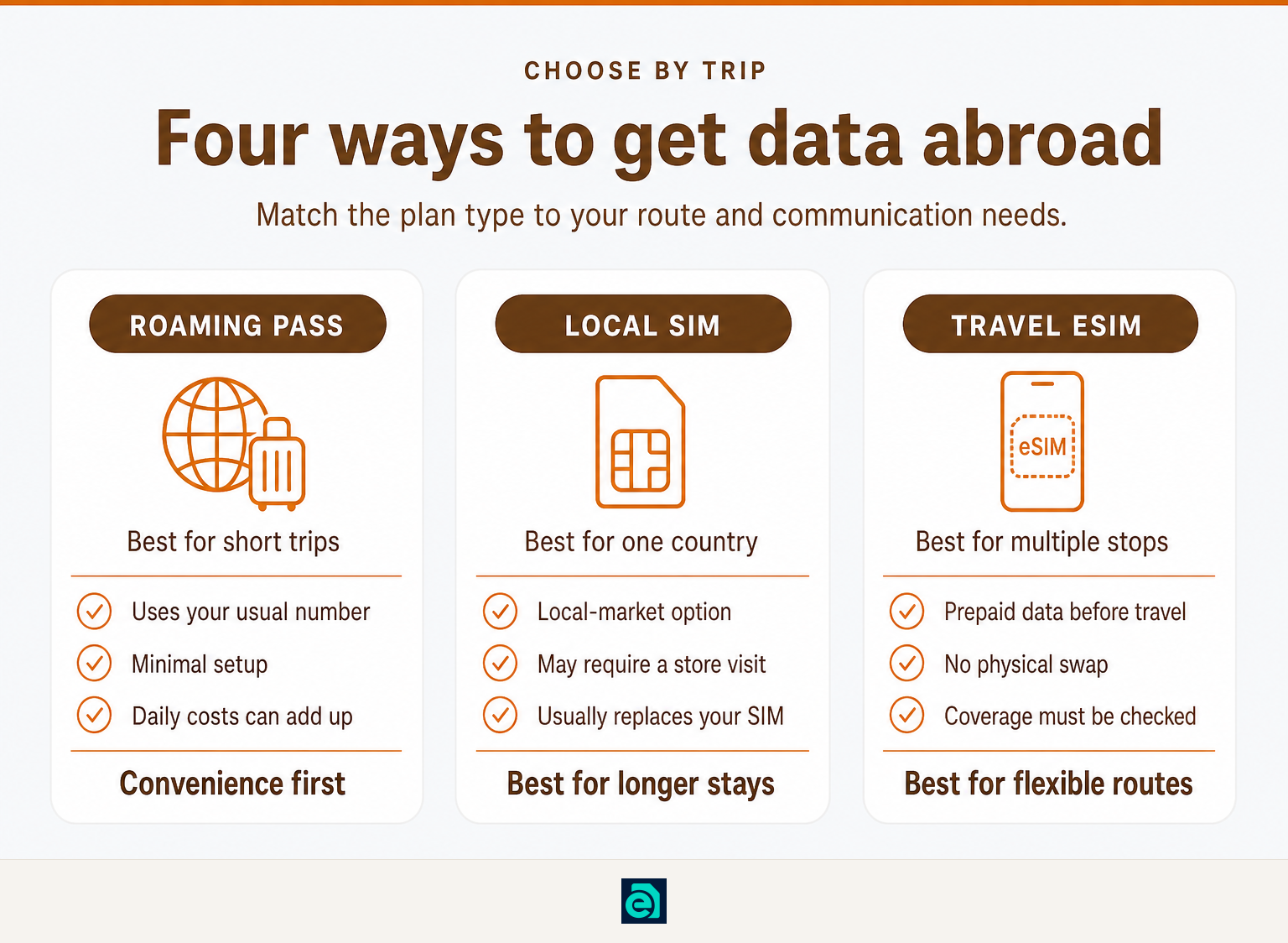
For most travelers, the best way to get mobile data abroad is a prepaid travel eSIM that matches the trip's geography: one country, one region, or multiple regions. A home-carrier pass is often easier for a very short trip, while a local physical SIM can still make sense for a long stay in one country.
There are four practical options.
| Option | Best for | Main advantage | Main trade-off |
|---|---|---|---|
| Home-carrier roaming pass | A short trip or an arrival-day backup | Your existing number and phone setup stay in place | Charges can accumulate by day and plan terms vary |
| Local physical SIM | A longer stay in one country | Potentially good local value and, sometimes, a local number | Requires a store visit or delivery and may mean swapping SIMs |
| Regional travel eSIM | Several countries in one region | One prepaid data profile for a multi-country route | Covered-country and network lists must be checked |
| Global travel eSIM | Trips across regions or repeat travel | One reusable profile and broad geographic coverage | Usually unnecessary for a single-country vacation |
A travel eSIM is normally installed before departure or when you have Wi-Fi. It can be used for maps, ride-hailing, messaging, email, mobile boarding passes, and internet calling apps while your primary SIM remains active for your usual number, if your phone supports that setup.
The practical answer is simple: buy for the route you will actually travel, not for a theoretical list of countries you may never visit.
When does a home-carrier roaming pass make sense?
A home-carrier roaming pass makes sense when convenience matters more than finding the lowest prepaid data price, especially for a short trip. It can also be useful when you need your ordinary phone number ready immediately for calls, texts, or account verification.
A pass generally works by adding an international allowance or a daily fee to your existing plan. The easy setup is the attraction. Your phone already has your home SIM, contacts, and number, so there is less to configure before a two- or three-day trip.
The weakness is the cost structure. A daily fee may feel acceptable on day one but become poor value on a two-week itinerary, particularly if every travel day triggers the charge. Some plans also reduce speed after a high-speed allowance, limit hotspot use, or cover fewer destinations than expected.
Before enabling data roaming, make sure you know what event starts the charge. Travelers who want a deeper explanation of activation triggers can read how much are international roaming charges, and what triggers them?.
A home-carrier pass is usually a convenience purchase, not an automatic best-value purchase.
Is a local physical SIM still worth buying?

A local physical SIM is still worth buying when you will spend a long time in one country and want an option designed for that local market. It is less appealing when you are moving quickly between countries or your phone has only one physical SIM slot.
The local-SIM approach is familiar. You buy a card after arrival, insert it into an unlocked phone, and use a local network. Depending on the destination and seller, the purchase process may involve a passport, local registration requirements, an activation wait, or a visit to a retail store.
That process can be reasonable when you have time and expect to use a large amount of data in one place. It is less convenient if you land late, need directions before reaching your accommodation, or want to keep receiving service on your home SIM.
A physical SIM can also complicate dual-number use. Removing your home SIM may prevent ordinary calls and texts from reaching that number until you put it back. For a closer look at the hardware and travel trade-offs, compare an international SIM card or travel eSIM before choosing.
A local SIM is most useful when the trip is long, single-country, and flexible enough to accommodate an in-person setup.
When should you choose a regional or global travel eSIM?
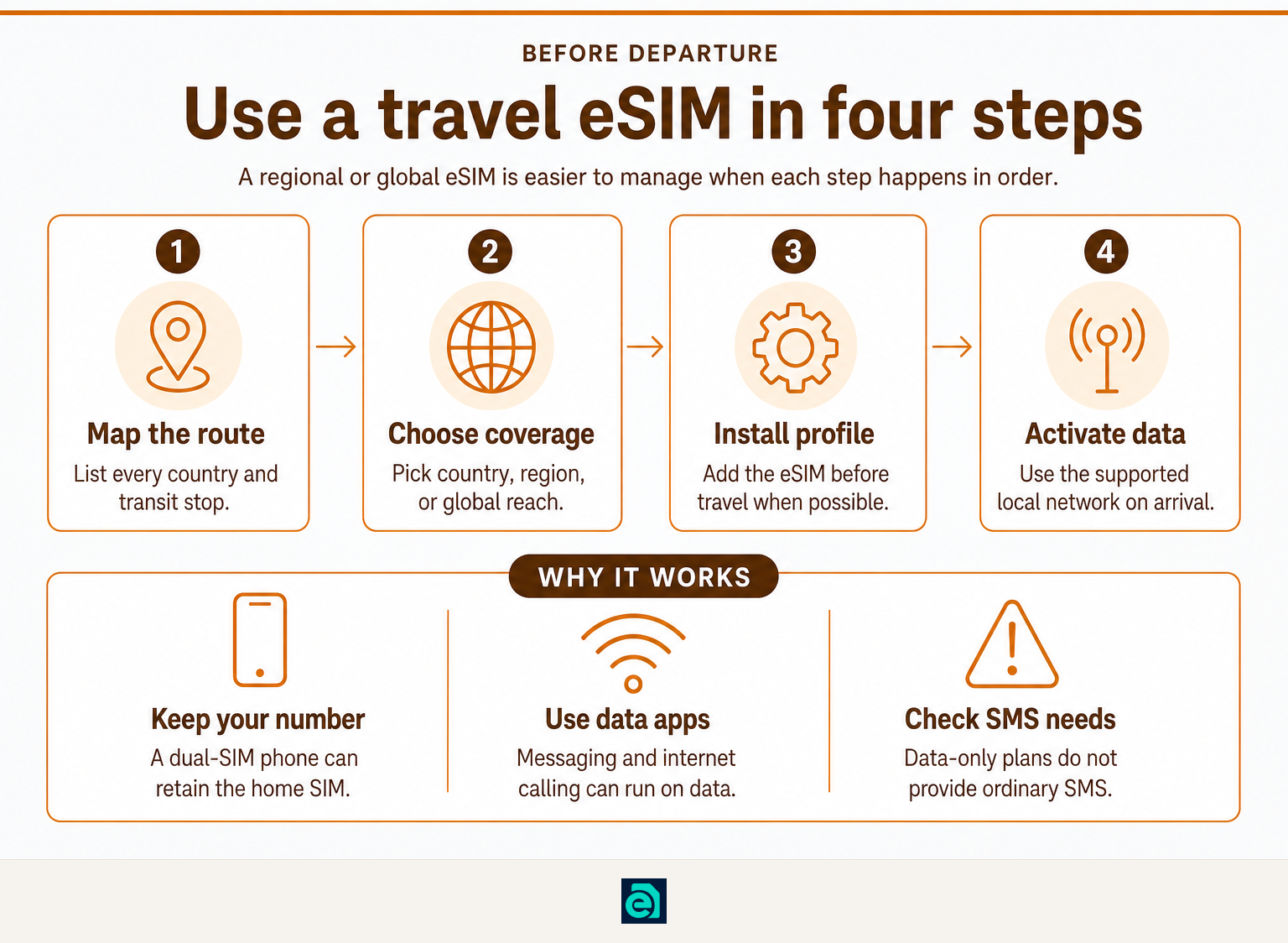
Choose a regional travel eSIM when your itinerary stays within one supported region, such as Europe or Asia. Choose a global travel eSIM when your route crosses regions, changes unexpectedly, or involves several trips over a longer period.
The important distinction is not the word "international." It is coverage shape.
A country eSIM is focused on one destination. A regional eSIM can avoid buying and installing a separate plan at every border crossing, provided all planned countries are included. A global eSIM is designed for wider travel, but broad coverage does not automatically mean it is the best-value option for a short trip to one country.
At eSIM Trading, we sell prepaid data-only country, regional, and global eSIM plans. The current global travel eSIM plans list coverage, validity periods, supported networks, and hotspot availability so travelers can check the plan against their route before purchase.
Data-only is a meaningful limitation, not a footnote. A data-only eSIM does not supply a standard phone number and cannot receive normal SMS one-time passwords. Use internet calling and messaging apps over data where appropriate, but keep your home SIM active or arrange another solution if a bank, airline, employer, or government service requires a standard text message.
A regional eSIM is usually the cleanest option for a regional itinerary, while a global eSIM earns its place when your route crosses regions or repeats over time.
How do you compare international data plans without a misleading price?
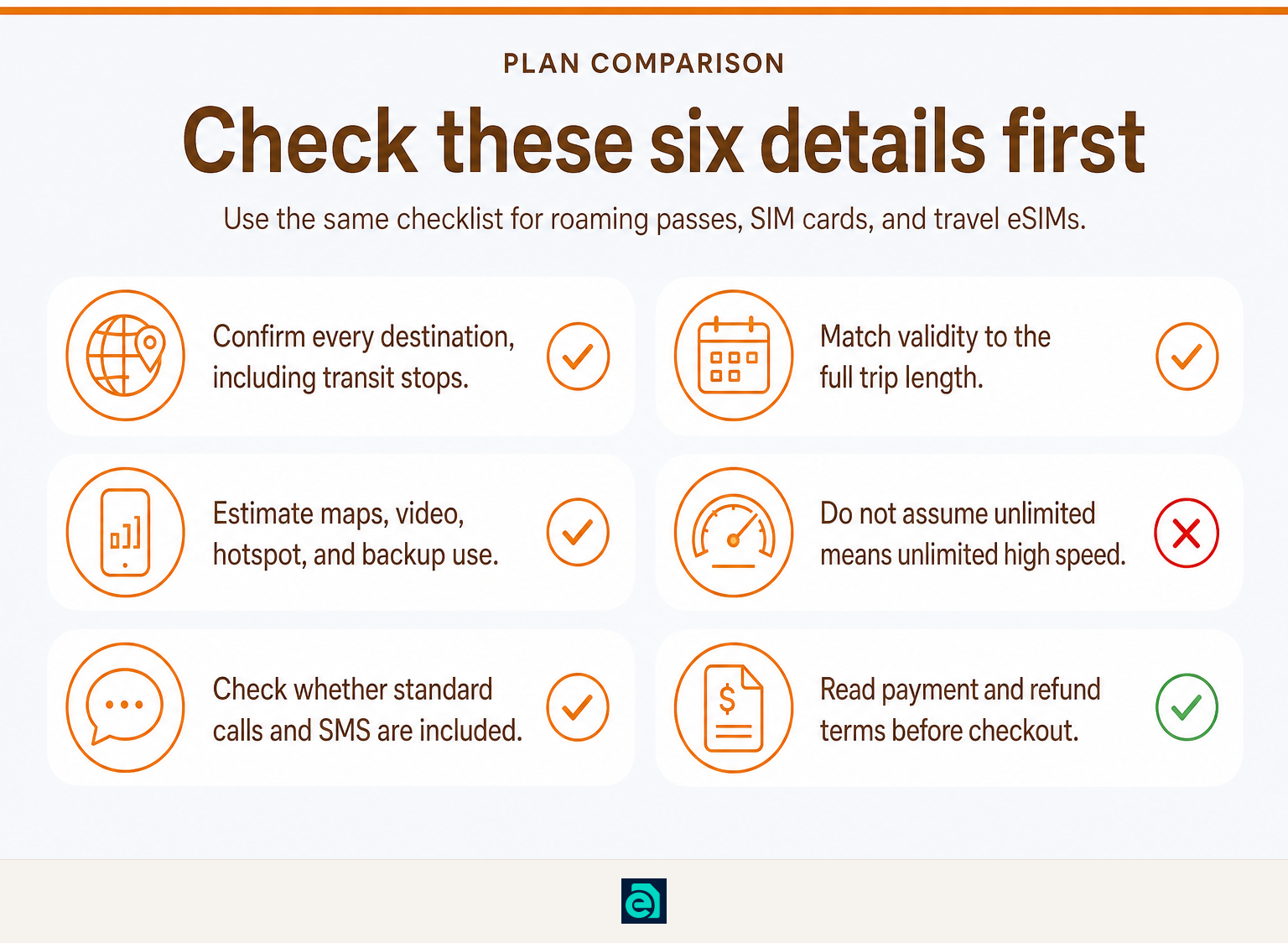
Compare international data plans by total trip cost and usable data, not by the largest number in an advertisement. A lower headline price can be a worse deal if the plan expires too soon, excludes a destination, reduces speed quickly, or requires a separate plan at the next border.
Use this comparison sequence:
- Map every destination. Include transit stops, side trips, islands, and any country where you expect to leave the airport.
- Count active days. A plan that lasts seven days is not equivalent to one that lasts 30 days, even when the data allowance is similar.
- Estimate your actual usage. Maps and messages use far less data than video uploads, high-resolution streaming, laptop tethering, or cloud backups.
- Check whether the plan is data-only. If you need standard calls, SMS, or SMS verification codes, data alone may not be enough.
- Read the high-speed and fair-use terms. "Unlimited" can mean continued access at reduced speeds, not unlimited high-speed data.
- Confirm the checkout method and refund rules. Payment options and digital-goods refund terms differ by seller and can change.
A prepaid eSIM can make trip budgeting clearer because the allowance and validity are selected before activation. It does not remove the need to read terms. If avoiding accidental roaming is your main goal, see how can I avoid roaming charges while keeping mobile data available.
The fairest comparison is the plan that covers your full itinerary and expected use for one known total, not the plan with the most attractive first number.
What must you check before buying an international data plan?
Before buying any international data plan, confirm that your phone is carrier-unlocked, compatible with the selected SIM or eSIM format, and supported in every destination on your route. Then check validity, network coverage, hotspot rules, fair-use thresholds, activation timing, payment method, and refund conditions.
The details behind unlimited plans deserve extra attention. For example, eSIM Trading's Fair Usage Policy, last updated September 24, 2026, says its unlimited plans have indicative total allowances of 30 GB for seven days, 45 GB for 15 days, and 70 GB for 30 days. The policy says the first 500 MB is at full speed, speeds are then typically limited to 5 Mbps, and a further reduction can apply near the end of the allowance.
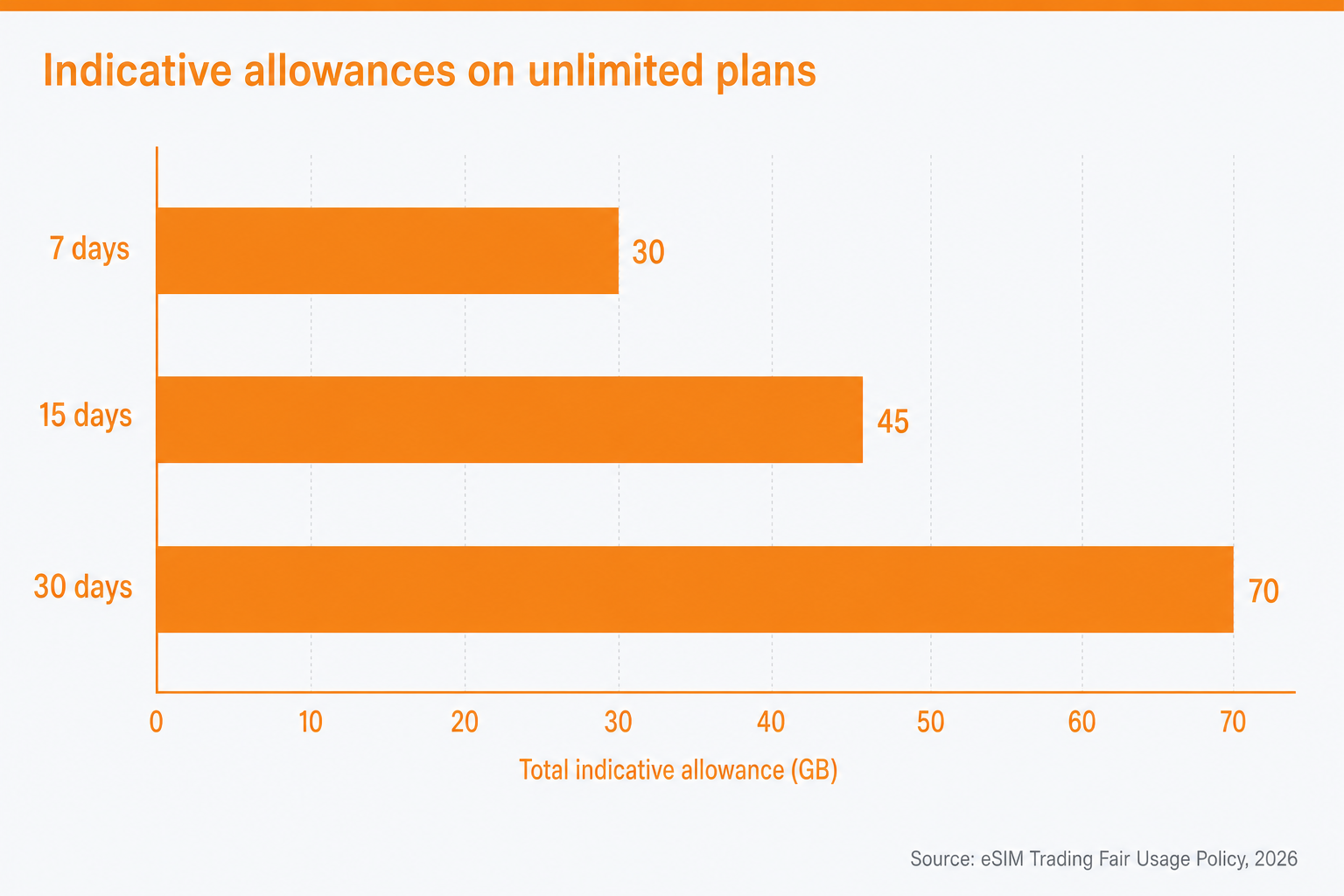
Those figures are specific to one seller's listed unlimited plans, not a universal definition of unlimited international data. The policy also says the thresholds are indicative and can change, which is exactly why travelers should read the current policy for any plan they consider.
Finally, do not install an eSIM in a rush without saving the activation details. eSIM Trading's September 2026 Terms state that a delivered profile cannot be reused after it has been installed or removed, and that the activation code should be kept private because anyone with it may be able to install the profile.
The safest purchase is one made after checking the current destination list, plan rules, and phone requirements, not after seeing the word unlimited.
Frequently asked questions
How expensive is international data?
International data can cost very little or become expensive quickly depending on the pricing model. A prepaid eSIM has a known allowance and validity period, while a daily roaming pass can add a charge for each active travel day. Compare the total for the entire itinerary, including expected data use, rather than judging one day's price alone.
Do I get charged for calling a US number that is abroad?
Charges depend on the caller's plan and the traveler's roaming arrangement. A person dialing a US number may be treated as making a domestic US call by their provider, while the traveler abroad may face roaming charges for making or receiving a standard cellular call. Check both plans before relying on voice service.
Which international roaming plan is best?
The best international roaming plan is usually the one that covers every destination, lasts for the full trip, and includes enough high-speed data for your use. A home-carrier pass is often best for convenience on a short trip. A prepaid regional or global eSIM is often better suited to longer or multi-country travel.
Which cell phone provider is the cheapest?
No single cell phone provider is always the cheapest because destination coverage, domestic-plan eligibility, daily fees, and data limits differ. Compare the full cost for your travel dates and expected usage. For one-country or multi-country travel, include local SIM and prepaid travel eSIM options in the same comparison.
The best international data plan is the one that matches your route, data demand, and communication needs without charging for coverage you will not use.
What should you do next?
Write down every country on your itinerary, decide whether ordinary calls and SMS are essential, then compare plans by total trip cost, validity, and usable data. If your trip spans several countries or regions, start with a prepaid regional or global eSIM and verify each destination before activating it.
Ready to travel without roaming bills?
Instant eSIM data plans for 148 countries — delivered as a QR code in under a minute. No account, no contract.
Browse destinations